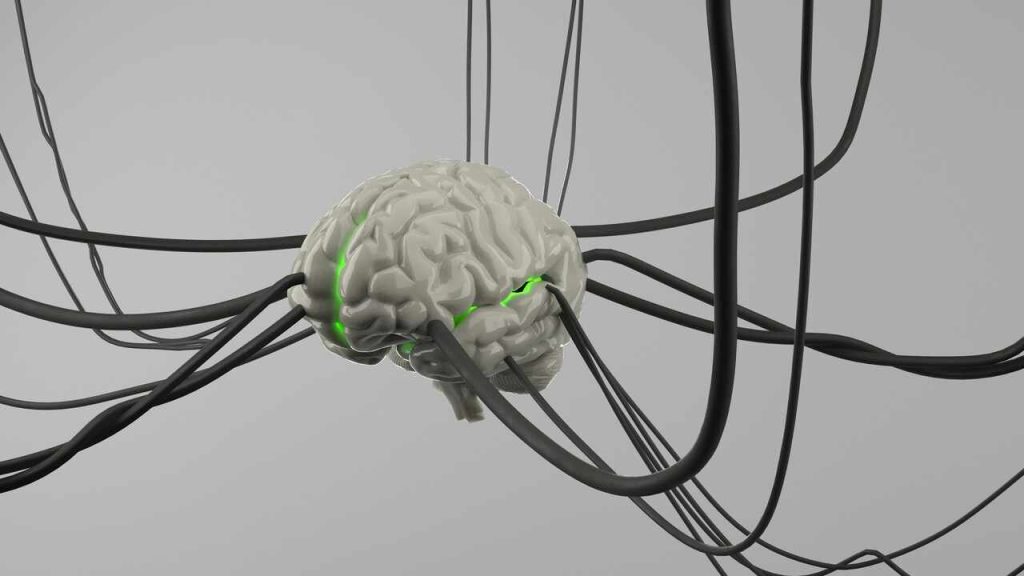
When your entire body becomes paralyzed, you do not just lose movement. You often lose your voice and the ability to write, too. For many patients, the only option left is eye-tracking technology, where they look at letters on a screen and spell out words one by one. It works, but it is slow, tiring, and frustrating for everyday conversation.
A new study from researchers at Mass General Brigham Neuroscience Institute and Brown University suggests communication could look very different. As part of the BrainGate clinical trial, the team tested an experimental implantable brain-computer interface that allowed two paralyzed patients to type using only their brain activity. The results were published in Nature Neuroscience.
One participant had advanced amyotrophic lateral sclerosis (ALS), a disease that gradually destroys the nerve cells that control muscles. The other had a cervical spinal cord injury. Both tested a new implant that captures signals from the brain and converts them into text on a screen.
A new study from Brown and Mass General Brigham Neuroscience Institute shows how an implantable brain-computer interface enables rapid, accurate typing for people with ALS and spinal cord injuries — helping restore communication after paralysis. https://t.co/ye3yJfUKJX
— Brown University (@BrownUniversity) March 18, 2026
The Brain Chips Do Not Read Complete Thoughts. They Decode Attempted Finger Movements
At first glance, it may sound like the device reads full thoughts. That is not the case. The system does not track entire sentences forming in a person’s mind. Instead, it captures something much more specific: attempted finger movements.

Researchers implant microscopic electrodes in the motor cortex, the part of the brain that controls movement. A standard QWERTY keyboard is displayed in front of the patient. Each letter is mapped not only to a specific finger but also to a particular finger position, such as up, down, or curled. It is similar to mentally replaying the motion of your hand moving across a keyboard—even though your body does not actually move.
When the patient attempts that movement, the electrodes record electrical activity in the brain. A computer then translates those signals into specific letters. A language model also helps refine the output and reduce errors. In simple terms, the brain sends a signal, the system interprets it, and the software turns it into readable text.
Typing Speed Is Getting Closer to Real Conversation
The results surprised even the researchers. One participant reached a top speed of 110 characters per minute, or about 22 words per minute. That is still slower than typical typing on a phone or laptop, but for people who would otherwise communicate very slowly, it represents a major improvement.
The error rate was just 1.6%. With this kind of technology, speed alone is not enough. If the system makes too many mistakes, communication still breaks down. That is why the combination of