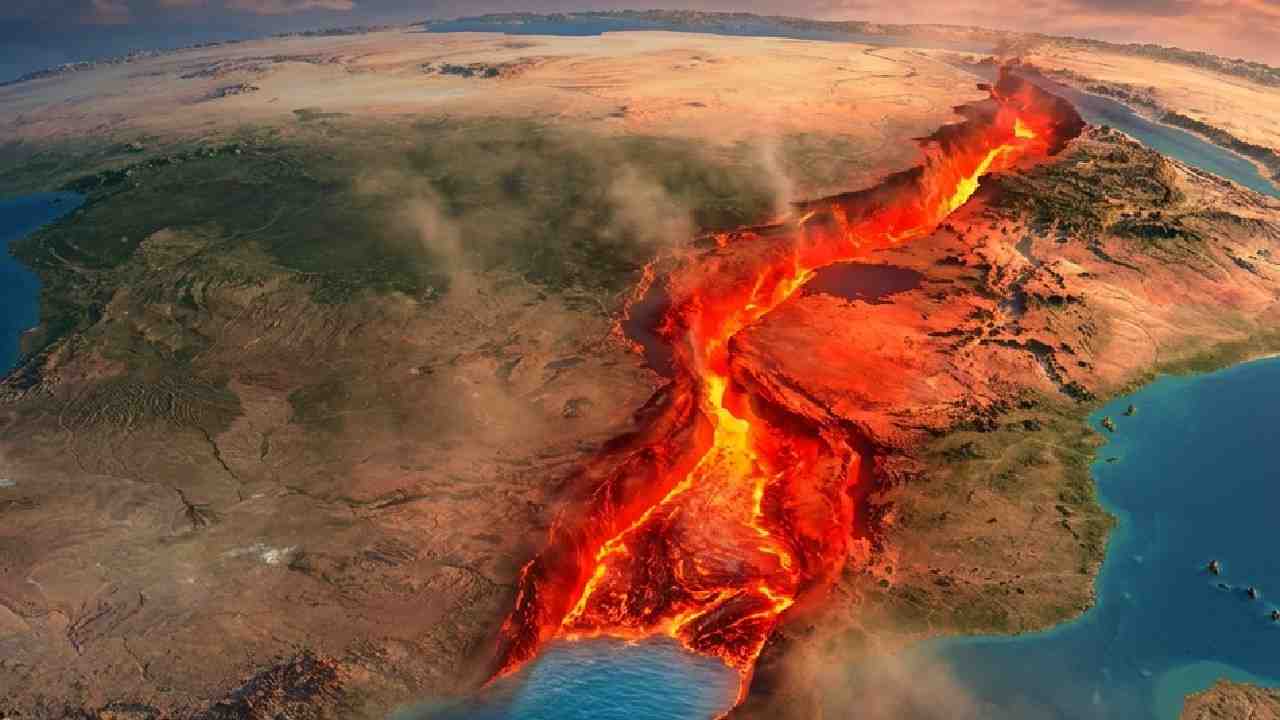
When you look at a map of Africa, it looks like one solid continent. But beneath the surface, the eastern side has been stretching, cracking, and slowly pulling away from the rest of the landmass for millions of years. No one could watch this unfold in a single lifetime. On a geological timescale, though, it’s a massive process that could eventually redraw the map of East Africa. Researchers from Columbia University now say one of the system’s most critical stretches is further along than scientists previously thought.
The region is called the Turkana Rift, stretching across parts of Kenya and Ethiopia. It’s a broad, low-lying zone where Earth’s crust is being pulled apart, almost like taffy stretched from both ends. The Turkana Rift is about 500 kilometers wide, or roughly 310 miles, and it belongs to the much larger East African Rift System, which runs from Ethiopia down toward Mozambique. This is one of the places where Africa is very slowly opening up, and if the process continues long enough, it could eventually help form a new ocean.
Earth’s Crust Beneath the Turkana Rift Is Thinning Like Pulled Taffy
Imagine stretching a piece of saltwater taffy from both ends. The middle narrows and lengthens, while the thicker ends stay mostly unchanged. Something similar is happening to Earth’s crust beneath the Turkana Rift. The difference? This takes millions of years, not seconds. As the crust thins, it weakens, letting tectonic stress focus in that zone.
Using high-quality seismic measurements, the researchers found that the crust along the rift’s center is now only about 13 kilometers thick, or roughly 8 miles. That’s a big contrast to areas farther from the rift axis, where the crust exceeds 35 kilometers, or about 22 miles. Geologists call this kind of thinning “necking”—a stage where continental crust stretches, narrows, and edges closer to breakup.
“We found that rifting in this zone is more advanced, and the crust is thinner, than anyone had recognized,” says study lead author Christian Rowan, a PhD student in Earth and Environmental Sciences and researcher at the Lamont-Doherty Earth Observatory. “Eastern Africa has progressed further in the rifting process than previously thought.”
The Turkana Rift Has Reached a Stage Where the Crust Can Tear More Easily
The thinner Earth’s crust gets, the less resistance it offers to stress from moving tectonic plates. Picture a piece of fabric or plastic that’s worn thin in one spot—that’s where tearing is most likely. That’s why scientists say the Turkana Rift has entered a highly advanced stage, where deformation is no longer spread evenly but focuses along the rift axis.
In this region, the African plate and the Somali plate are drifting apart at about 4.7 millimeters per year. To us, that’s barely noticeable—less than a fingernail grows in a few weeks. But in geology, where changes unfold over millions of years, that steady motion can gradually weaken an entire continental block.
“We’ve reached that critical threshold” of crustal breakdown, says Anne Bécel, a geophysicist at Lamont and co-author of the study. “We think this is why it is more prone to separate.”
A New Ocean in East Africa Won’t Appear Tomorrow, but the Process Has Been Underway for Millions of Years
The Turkana Rift didn’t start pulling apart recently. According to the researchers, this part of East Africa began opening roughly 45 million years ago. The more intense crustal thinning kicked in much later, about 4 million years ago, after widespread volcanic activity. So this isn’t a sudden disaster. It’s an extremely slow tectonic process, reshaping a continent step by step.
A full breakup of East Africa is still a very long way off. Scientists predict millions of years before the rift advances to the next stage, called oceanization. There, magma would surge through the weakened crust, building new seafloor. If that plays out, water from the Indian Ocean could flood the basin, forming a new ocean between Africa’s separated parts.
The researchers also found evidence of an earlier rifting phase. That older episode didn’t lead to breakup, but it left the crust weakened and thinned—setting the stage for today’s activity in the Turkana Rift. Continents don’t always split in one clean event; older and newer weak zones can align over millions of years into one larger process.
The Turkana Rift May Not Have Been Just a Cradle of Humankind, but Also a Perfect Place to Preserve Fossils
The Turkana Rift isn’t famous only for thinning crust. It’s also one of Earth’s top spots for studying human evolution. Over the past 4 million years, the region has yielded more than 1,200 hominin fossils—remains of our ancient ancestors and their close relatives. That’s about one-third of all such fossils from Africa, making Turkana a pivotal hub in the narrative of human evolution.
The new research points to another factor. After widespread volcanic activity about 4 million years ago, stronger crustal thinning began. The land sank, and fine sediments rapidly filled the basin—like a natural blanket preserving bones, teeth, or footprints from water, wind, or decay.
“The conditions were right to preserve a continuous fossil record,” says Rowan.
That shifts our view of Turkana’s fame. It may not just be where our ancestors evolved more intensely—its geology was also unusually good at saving the evidence. Similar fossils likely existed elsewhere, but nature may have erased, scattered, or buried them too deeply to find today.
The Turkana Rift Shows What Happens Before a Continent Becomes a New Ocean Basin
What makes Turkana so valuable is that this isn’t an ancient, finished story—the process is still active. It’s the first known active continental rift showing this advanced stage of crustal necking. These aren’t just old scars; the ground is still shifting, just too slowly for any human generation to notice directly.
The region reveals what happens to a continent before it fully breaks and new oceanic crust forms. Similar processes shaped coastlines and ocean basins worldwide, but most places show only the end result. In Turkana, scientists get a rare live look at a key stage in action.
The story goes beyond geology. Tectonic shifts altered land height, river paths, sediment buildup, and fossil preservation conditions. Turkana isn’t just a lab for Africa’s potential breakup—it’s a reminder that Earth’s slow movements decide which life stories endure in the fossil record, and which vanish forever.