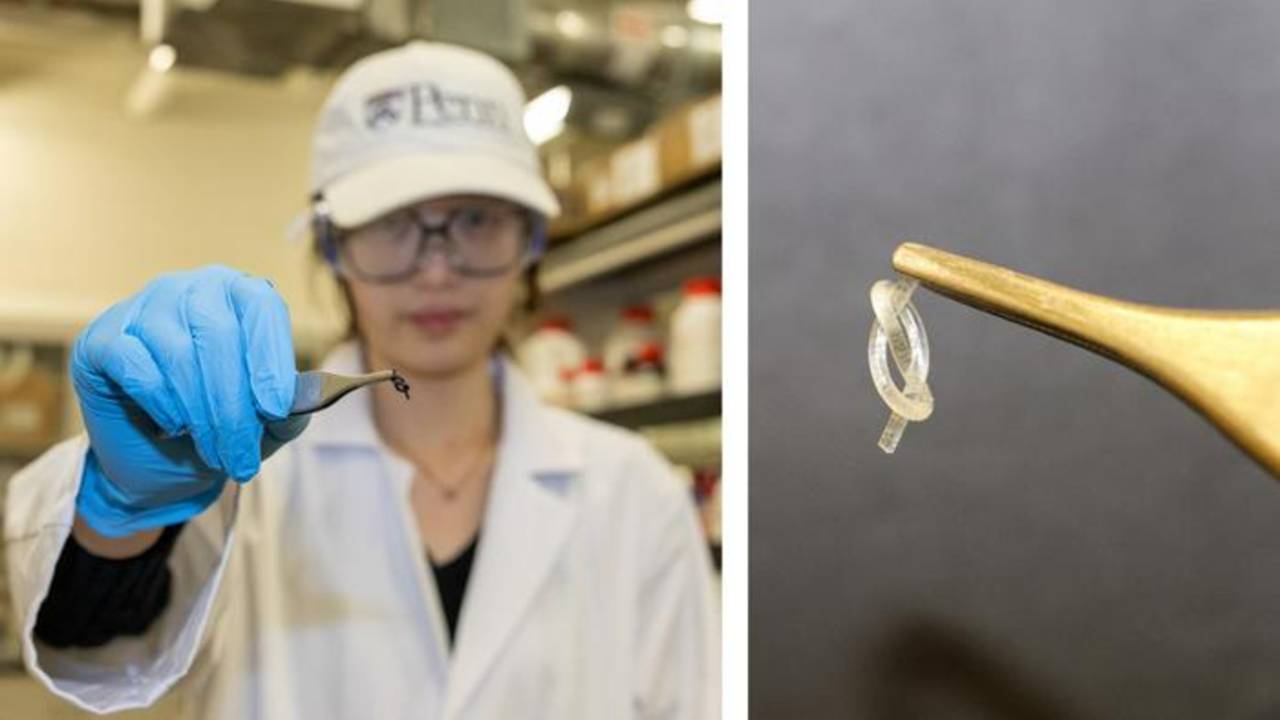
When your shoelace comes undone, it’s usually just a minor hassle. You bend over, tie it back up, and keep going. But in that quick moment, something pretty wild is going on. A knot doesn’t always loosen up nice and slow. Under the right setup, it can snap loose and unleash all the energy bottled up inside. Engineers at the University of Pennsylvania spotted this and wondered: what if we designed a knot not to stay tied, but to let go exactly when we want?
That sparked a cool new type of tiny soft robot, smaller than your pinky finger, that can leap nearly two meters—or about six feet—straight up. Compared to its size, it’s downright crazy. Picture a little thing on your desk blasting off toward the ceiling out of nowhere.
Tiny Knotted Robots Can Jump without a Motor. They Only Need Heat and a Carefully Designed Fiber
The setup’s like a spring locked down by a latch—and here, the knot’s the latch. Think about stretching a spring and holding it tight so it can’t budge. The energy stays trapped as long as that latch holds. In this case, it’s all packed into a twisted, knotted fiber.
Crank the heat to 60 to 90 degrees Celsius (140 to 194 Fahrenheit), and the special stuff around the knot starts shrinking and untwisting. That loosens things up just enough for a sudden snap. The fiber whips itself free, dumping all that twist energy in one go.
In a split second, that elastic energy explodes into action. It looks explosive. A knot just millimeters long can hurl itself nearly two meters high—no motor, no battery, no electronics needed.
Led by @ShuYangPenn, Joseph Bordogna Professor in @MSEatPenn, Penn Engineers have created a programmable knotted fiber that stores energy when twisted and releases it when heated, allowing it to jump, spin and even plant seeds.
“People think of a knotted fiber as something… pic.twitter.com/ARBUTQgi2L— Penn Engineering (@PennEngineers) April 23, 2026
The secret sauce is blending two totally different materials. At the core, there’s Kevlar for serious strength and packing in extra mechanical energy. Wrapped around it is a liquid crystal elastomer shell, which flips its behavior when heated. Kevlar’s the rigid spine; the elastomer’s the heat-sensitive trigger that kicks everything off.
“People think of a knotted fiber as something passive,” says Yang. “But if you design the elasticity and materials carefully, the knot itself becomes an active system.”
The Type of Knot Changes How the Tiny Robot Moves, Spins and Lands
What’s even cooler is how the knot type dictates the robot’s post-jump antics. A basic overhand knot makes it flip. A figure-eight sends it spinning. Trickier knots unravel in steps, creating mini midair gymnastics routines.
Tack on a wing, and you’ve got real control. It draws from maple seeds, those helicopter-like samaras that twirl away from the parent tree. Some winged bots glide forward and land way out. Others loop back like boomerangs to the takeoff spot.
Tiny Robots Could One Day Help Plant Seeds in Dry Regions
Seed planting might be this tech’s killer app. Past robotic seed droppers depended on rain to kick in—which had big issues. Torrential downpours could wreck or wash away seeds, and bone-dry spots might never trigger at all.
Now it’s heat-powered, ditching water entirely. Sun’s way more reliable than rain in lots of places, and it sets off the fiber’s action. In scorching areas, ground, rocks, and surfaces hit temps that easily activate it.
“We don’t always have rain, but we do have sun,” Yang says.
It’s no weak jump either—the system packs 30 times the soil penetration pressure of their old rain-based carriers. In tests, they stuck pine and arugula seeds on these knot-jumpers. Once they hit dirt and burrowed in, the seeds sprouted just fine.
The Knotted Robots Jump Higher Because Kevlar and Elastomer Work Together
The game-changer was adding that Kevlar core. The added rigidity let the fiber cram in way more energy, boosting jump height from one meter to almost two. That’s on par with a springtail’s epic leaps—that tiny bug famous for its explosive soil jumps.
“They are on opposite ends of the spectrum,” says Hong. “Kevlar provides rigidity such that it resists deformation. LCEs, on the other hand, provide thermal actuation. Together, they achieve dynamic behaviors that were not possible by traditional soft robots. And, while we have shown success in the coupling of these materials, we can further optimize this particular material combination to achieve different functions.”
The Future of Soft Robots May Not Need Batteries, Motors or External Power
It’s not ready to drop from drones over forests yet. The team calls it a proof-of-concept to test energy storage, knot release, and soil impact. For real-world use, materials need to go greener too.
Activation temp’s another hurdle—60 to 90 Celsius won’t fly everywhere. They’re already tweaking it lower. That’s when we’ll know if it can tackle farming, land rehab, or hard-to-reach seed drops.
Here’s the mind-blower: no battery, chip, or motor required. It runs on fiber tension, ambient heat, and knot shape. The leap mimics tiny dirt critters; the wing copies maple seed spins.
The whole thing started simple—no big robot blueprint. Just a knot and curiosity about what happens when it pops loose. Turns out, a everyday shoelace fail can inspire a palm-sized powerhouse that rockets skyward.