Dark matter is often described in textbooks as something quiet, cold, and almost untouchable. But new research suggests the reality may be far wilder. According to physicist Hai Bo Yu, in certain situations it may behave more like a dense crowd, with particles constantly bumping into one another. And that kind of behavior could explain three cosmic mysteries at the same time.
Physicist Hai Bo Yu of the University of California, Riverside has proposed a model that goes against the usual picture of dark matter as something passive and almost impossible to disturb. Instead of particles that simply pass by one another without contact, he suggests a scenario in which dark matter particles collide and exchange energy.
Dense clumps of dark matter could be as massive as millions of Suns
A study published in Physical Review Letters describes extremely dense clumps of self interacting dark matter with masses about a million times greater than that of the Sun. According to the author, objects like these could explain three different phenomena that have puzzled astronomers for quite some time.
The standard model assumes that dark matter is “cold” and essentially collisionless, meaning its particles pass through one another without strongly affecting each other. That picture works well on large scales, but it struggles to explain some of the unusually dense structures we observe in the universe. That is why Yu focuses on what is known as self interacting dark matter, or SIDM.
“The difference is like a crowd of people who ignore one another versus a crowd where everyone is constantly bumping into everyone else. In SIDM, these interactions can dramatically change the internal structure of dark matter halos,” Hai Bo Yu explains.
The same kind of dark matter may be hiding behind three strange phenomena
The most interesting part of the study is that the very same mechanism could be operating in three completely different environments. So this is not about three separate explanations, but one model trying to hit three targets at once.
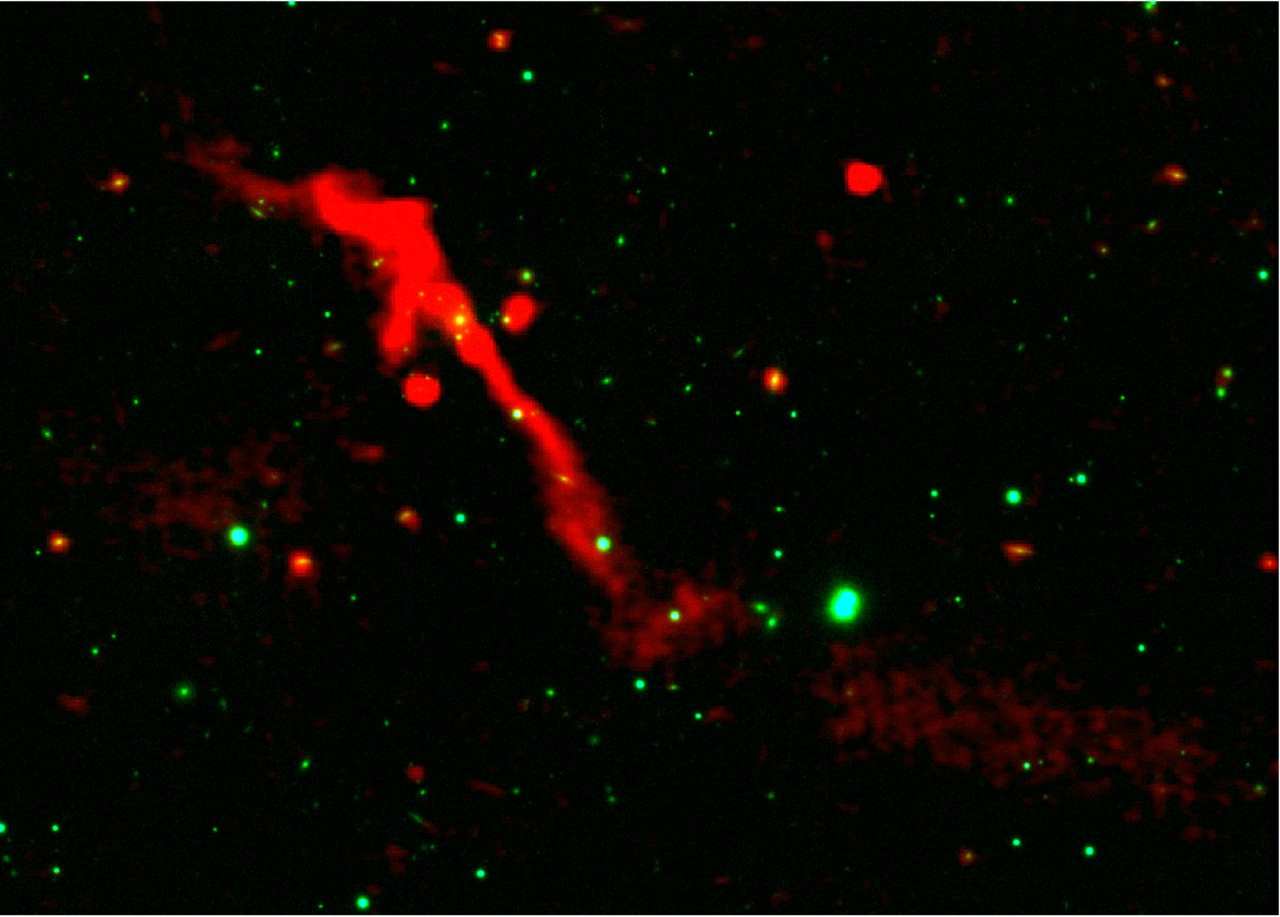
The first mystery involves the gravitational lens JVAS B1938+666. Observations suggest that something extremely dense is present in this system, distorting and amplifying the light of distant galaxies. Yu argues that a dense clump of self interacting dark matter could be the natural explanation for this anomaly.
The second case plays out much closer to home, inside our own Galaxy. The stellar stream GD 1 carries a strange “spur and gap” signature, essentially a protruding scar and a gap, as if an invisible but very compact object had punched through it. Here too, the model suggests the same type of dense dark matter halo could be responsible.
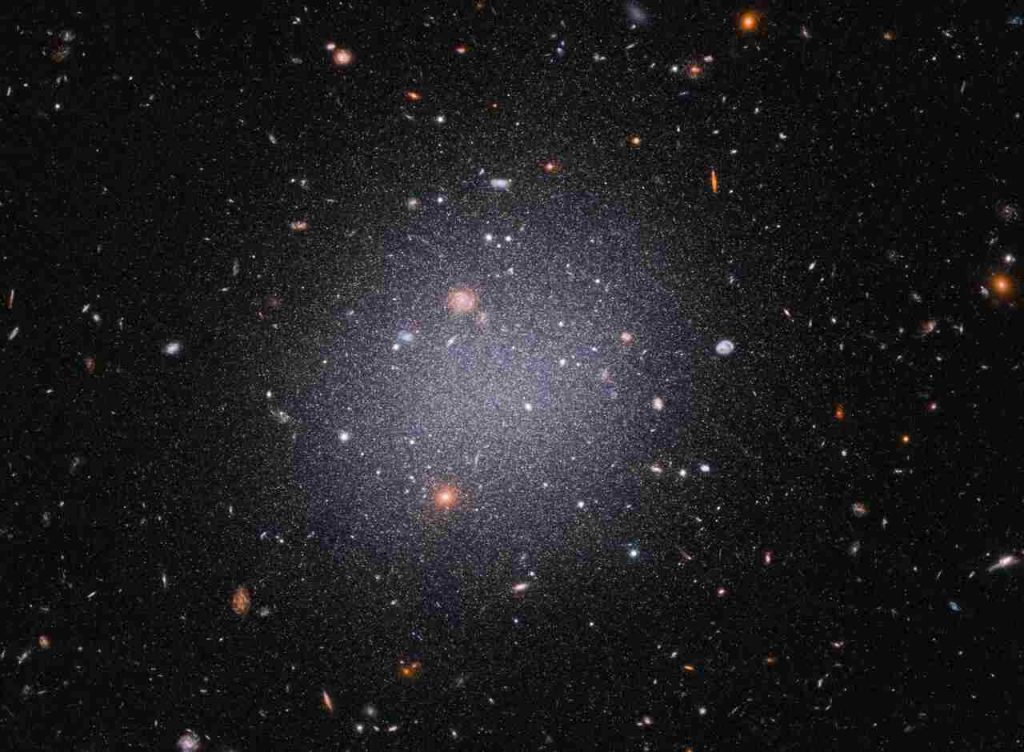
The third mystery lies in the dwarf satellite galaxy Fornax. The object Fornax 6 is unusually compact and dense. According to Yu, a dense dark matter clump could act there like an invisible gravitational trap, sweeping up passing stars and pulling them into a tight grouping.
Particle collisions may squeeze dark matter into an extremely dense core
The key process is something called gravothermal collapse. It sounds complicated, but the basic idea is fairly simple. When dark matter particles collide and transfer energy, the inner part of a halo can become extremely dense over time. The result is a compact core with a much higher density than you would expect in the standard non interacting model.
These observations make it clear where the standard model runs into trouble. It struggles to naturally produce objects with the kind of density suggested by observations of JVAS B1938+666, GD 1, and Fornax 6. According to Yu, SIDM does not force such objects into existence. It produces them as a natural consequence of how it behaves. That is exactly why this theory is drawing so much attention right now.
“What is striking is that the same mechanism works in three completely different environments, in the distant universe, in our own galaxy, and in a neighboring satellite galaxy. All of them show densities that are hard to reconcile with the standard dark matter model, but arise naturally in SIDM,” Hai Bo Yu said.
This theory does not prove dark matter, but it fits three anomalies remarkably well
This study does not mean scientists have finally cracked the dark matter mystery. What it does show is that the self interacting dark matter model fits three unusual observations much better than the standard scenario, in which the particles barely affect one another at all.
What matters is that the same problem is not showing up in just one place. If the same kind of dense invisible object appears in a gravitational lens, in a stellar stream, and in a satellite galaxy, it no longer looks like the sort of coincidence that can simply be brushed aside.
What matters now is whether astronomers will find more similarly dense and compact objects elsewhere. If they do, the idea of dark matter as something completely passive will take another hit. And that could change the way we look at this invisible part of the universe.