Something extraordinary is unfolding at the heart of the massive galaxy J1007+3540 — something astronomers rarely witness. A supermassive black hole that had slumbered for about 100 million years has roared back to life, unleashing powerful jets of plasma. These jets stretch nearly a million light-years across space.
Researchers from the Royal Astronomical Society have captured one of the sharpest views yet of a black hole reactivating. Radio data reveal not just its fresh jets, but also faded remnants from a prior active phase. In essence, astronomers are witnessing a cosmic timeline of a galactic core powering down, lying dormant for eons, and reigniting.
The Reawakened Core Carved Structures Nearly a Million Light-Years Long
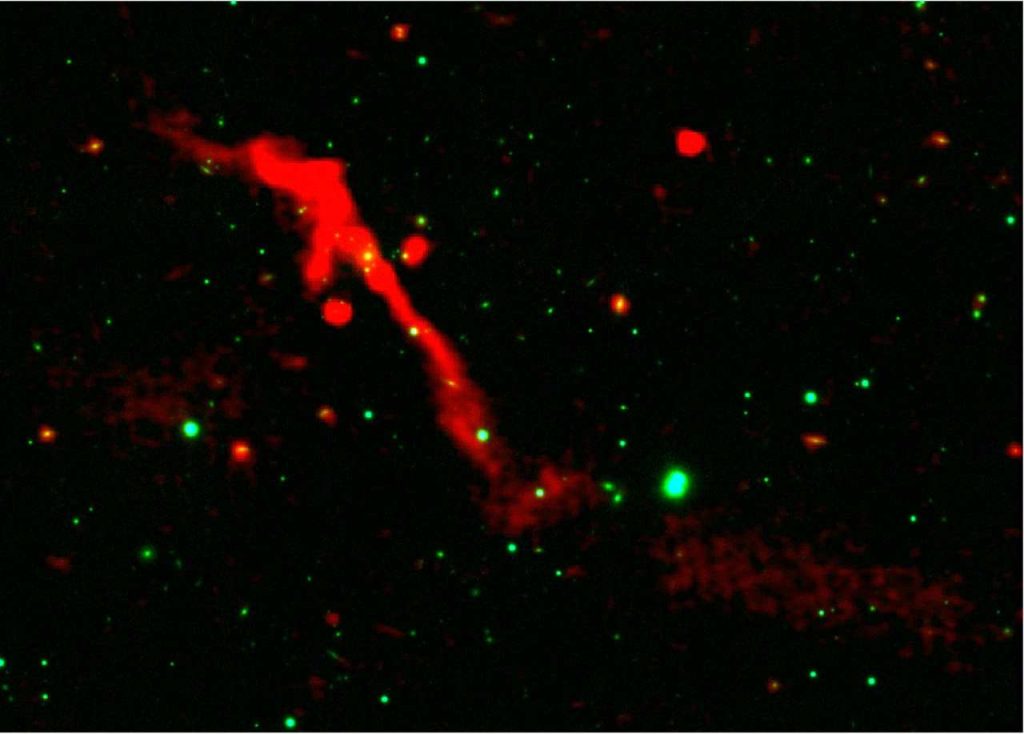
Radio images show a turbulent clash between the black hole’s new jets and the intense pressure of the surrounding environment. J1007+3540 isn’t isolated in the void — it’s embedded in a vast galaxy cluster brimming with scorching hot gas. This pressure warps, squeezes, and twists the jets.
“It’s like watching a cosmic volcano erupt after ages of dormancy, but this one carves structures spanning nearly a million light-years,” said Shobha Kumari of Midnapore City College.
The study appeared in Monthly Notices of the Royal Astronomical Society. The team leveraged two advanced radio interferometers: the Dutch Low Frequency Array (LOFAR) and India’s upgraded Giant Metrewave Radio Telescope (uGMRT).
Radio Data Reveals Prior Awakenings
Most large galaxies harbor a supermassive black hole at their core, but only a fraction unleash massive radio jets. J1007+3540 stands out because its repeated activity is strikingly clear. The core flared up before, went silent, and has now reignited.
Radio images spotlight a brilliant inner jet at the galaxy’s heart, signaling fresh black hole activity. Surrounding it are dimmer, older plasma lobes — echoes of an earlier outburst. This stark new-old contrast proves the core has cycled on and off multiple times over millions of years.
Data pin the older lobes to about 240 million years ago, with the inner jets at roughly 140 million years old — a 100-million-year hiatus between phases.
Surrounding Hot Gas Reshapes the Jets
J1007+3540 isn’t adrift in vacuum; it’s immersed in a galaxy cluster’s ultra-hot gas. This spells trouble for the newborn jets. They don’t expand into emptiness but slam into dense, pressurized gas.
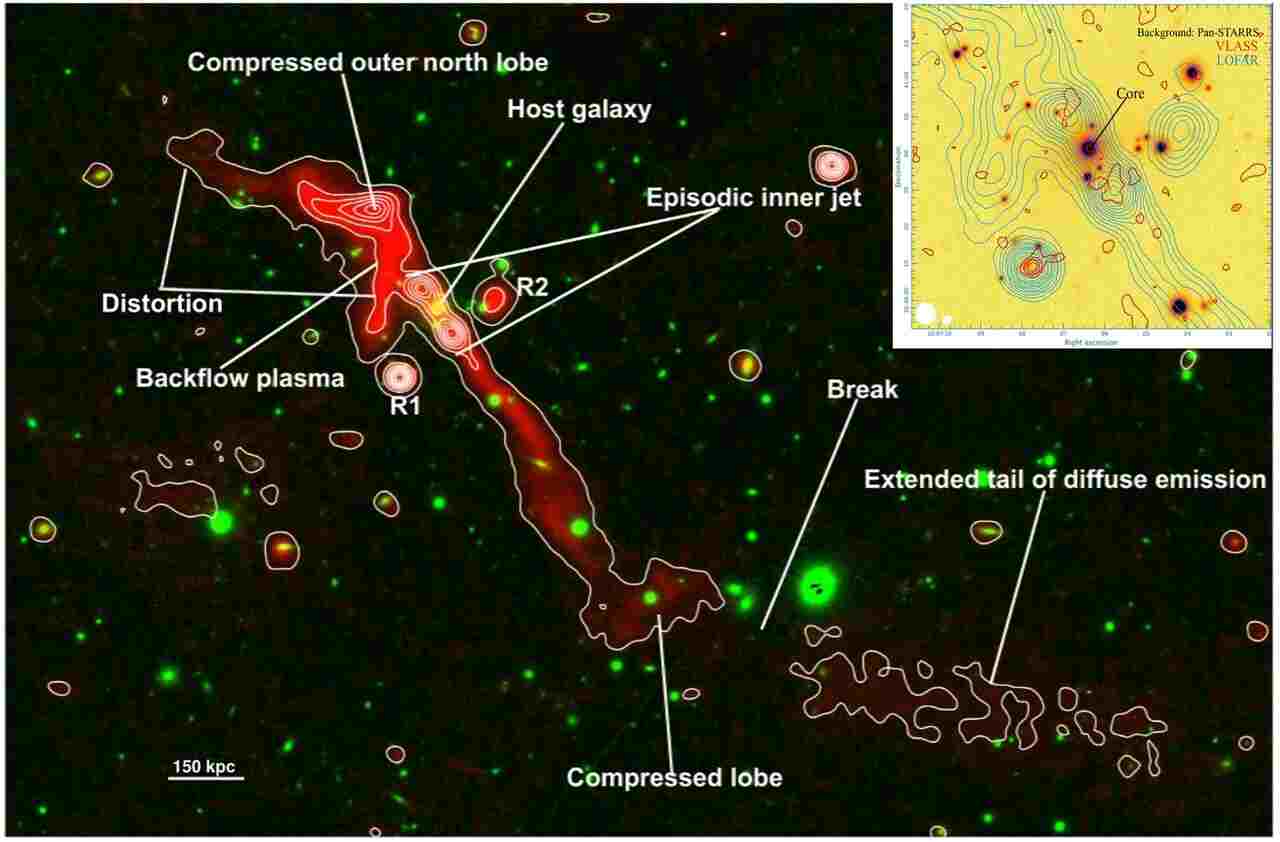
LOFAR images depict the northern lobe as compressed and severely bent, with a curved plasma backflow as if shoved sideways by the hot gas. uGMRT data indicate ancient, energy-depleted particles there, underscoring the cluster’s dominant role in sculpting these features.
The southern older lobe features a long, faint, kinked tail of diffuse emission stretching southwest. This implies magnetized plasma is dragged through the environment, trailing millions-of-years-old debris. Ultimately, the black hole reshapes its surroundings, but the cluster fights back — bending, slowing, and molding the jets.
J1007+3540 Reveals How Black Holes Remold Galaxies
With its episodic outbursts, immense scale, and hostile environment, J1007+3540 is a goldmine for astronomers. It proves galactic evolution is dynamic and disruptive. Core events can overhaul a galaxy’s structure, even after prolonged quiet.
“J1007+3540 is one of the clearest examples of episodic AGN activity interacting with a cluster, where hot gas bends, compresses, and distorts the jets,” said Dr. Sabyasachi Pal of Midnapore City College.
This galaxy tackles key puzzles: how frequently black holes cycle active-quiet, how aging radio plasma interacts with cluster gas, and how repeated blasts sculpt surroundings over eons.
Next Steps: Probing Deeper Into the Core
The team plans deeper scrutiny of J1007+3540, focusing on the core itself and the jets’ post-reactivation behavior. Finer observations could decode the hot gas’s influence and the jets’ distortions.