Cancer doesn’t just survive by hiding from the immune system. It also survives by creating an environment around itself where immune cells stop attacking at full strength. It is a bit like sending a patrol to the scene, only for the tumor to slowly cut off its radio, lower its power, and force it to pull back.
Researchers at McGill University have now focused on one of the fastest parts of this defense system. These are natural killer cells, known as NK cells, which act like a first-response unit against suspicious cells in the body. They can recognize damaged or cancerous cells and destroy them. The problem is that tumors can weaken this ability. A new study suggests that when two molecular brakes inside NK cells are temporarily released, these cells can become much tougher opponents for cancer.
Researchers Found Two Molecular Brakes Inside NK Cells That Weaken Their Attack on Tumors
At the center of the work are two proteins with technical names, PTPN1 and PTPN2. Inside NK cells, they act like brakes that keep the immune response under control. Normally, that is useful, because the immune system cannot be allowed to attack without limits. In cancer, however, this kind of brake can become a weakness, because the tumor environment can exploit it.
When the researchers suppressed both brakes, NK cells responded much more strongly. In preclinical experiments, the cells were better at killing cancer cells across several hard-to-treat tumor types. These included leukemia, glioblastoma, kidney cancer, and triple-negative breast cancer. In animal models, the approach also significantly slowed tumor growth, which is why researchers see it as a possible step forward for cell-based immunotherapy.
Michel L. Tremblay of McGill University is cautiously optimistic. According to him, the approach could matter most for patients who no longer respond to standard treatment.
“This approach is particularly promising for patients who currently have very few options, when standard treatments have failed,” said senior author Michel L. Tremblay, Distinguished James McGill Professor in McGill’s Department of Biochemistry and researcher at the Rosalind & Morris Goodman Cancer Institute.
Instead of Permanently Rewriting Immune Cells, Scientists Tried to Switch Them Into a Stronger Temporary Mode
One of the biggest questions in cell therapies is control. If you genetically alter a cell permanently, you may give it new abilities, but you also create a change that cannot be easily turned off once the cell is returned to the patient’s body. That is why the researchers chose a more cautious route.
Instead of rewriting NK cells at the genetic level, they used small molecules that temporarily interfere with the activity of PTPN1 and PTPN2. You can think of it as briefly switching off two brakes that normally keep the immune reaction restrained. The advantage is that this is not a permanent rebuilding of the cell, but a change that should be easier to control.
The researchers worked with two compounds, L598 and KQ791. These attach to the active sites on PTPN1 and PTPN2, the parts of the proteins that allow these molecular brakes to do their job. The key point is not the chemistry itself, but the result. After this treatment, NK cells responded more strongly to immune signals and attacked tumor cells more effectively.
A Small Amount of IL-2 Was Enough to Push NK Cells Into a More Aggressive State
After both proteins were suppressed, NK cells became more responsive to the cytokine IL-2. You can think of IL-2 as a chemical instruction from the immune system. It helps NK cells survive, activate, and attack cancer.
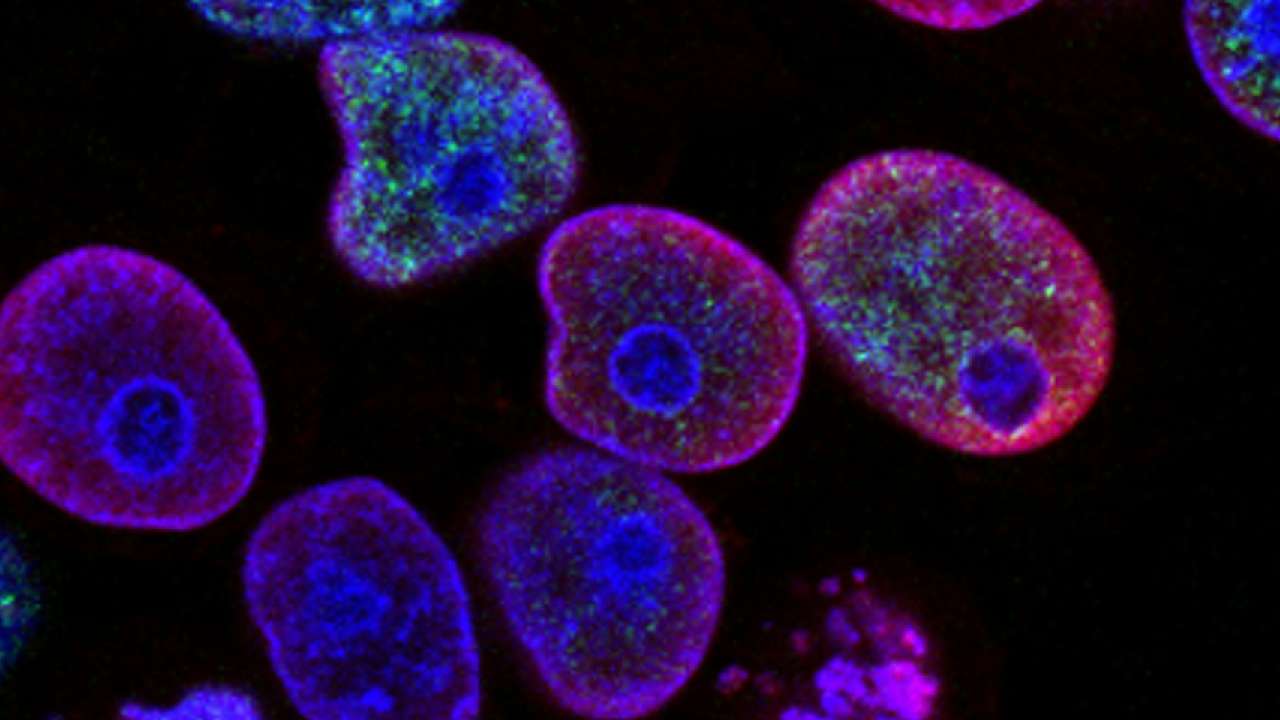
The treated cells started producing more granzyme B and perforin. These are molecules NK cells use to kill their targets. Perforin helps damage the surface of the target cell, while granzyme B helps trigger a process that leads to the cell’s death. At the same time, the cells showed higher levels of the CD25 receptor, which helped them pick up IL-2 signals more efficiently.
That matters because NK cells are not the only cells competing for IL-2 in the body. Regulatory T cells, which can dampen immune responses, also use this signal. If NK cells carry more CD25 receptors, they may be better able to use IL-2 in their own favor.
Tumors Use the Chemical Brake TGF-Beta1. Treated NK Cells Were Better Able to Resist It
Tumors do not play fair. It is not enough for them to grow quickly and escape normal control. They also create an environment that gradually blunts immune cells. One of the molecules they use for this is TGF-beta1. In simple terms, it acts like a chemical message telling immune cells to slow down, step back, and stop attacking at full force.
This is where the difference between ordinary and treated NK cells became clear. When the researchers exposed cells to the suppressive TGF-beta1 signal, NK cells with reduced PTPN1 and PTPN2 activity maintained higher activity. In other words, the tumor’s chemical brake had less power over them.
At the molecular level, the cells kept stronger activation of STAT1, STAT3, and STAT4 proteins. These proteins act like internal messengers. They carry information from the surface of the cell to its nucleus and help decide whether the cell stays suppressed or shifts into attack mode.
The researchers are not saying that they fully understand the entire mechanism yet. But the findings suggest that suppressing PTPN1 may be especially important in NK cells, because this protein appears to be present at higher levels than PTPN2. That may be one reason why turning down this brake helped the cells withstand some of the suppressive signals tumors use to protect themselves.
Immunotherapy Without Waiting for a Patient’s Own Cells: NK Cells From Cord Blood Could Be Prepared in Advance
Another major advantage is practical. Many cell-based immunotherapies today must be made individually from a patient’s own cells, a process that can take weeks.
This approach uses NK cells from donated umbilical cord blood. These cells can be processed, expanded, and stored in advance, which means they could potentially be ready for use without a long delay.
Chu-Han Feng of the research team sees this simplicity as one of the biggest advantages of the strategy.
“This approach could make immunotherapy safer and more affordable,” added Chu-Han Feng, a research scientist at the Rosalind & Morris Goodman Cancer Institute. “It avoids the complex process of customizing cells and uses readily available drugs to reversibly enhance NK cells’ anti-tumour activities.”
Not all donor NK cells responded in the same way, however. The researchers saw differences in how strongly the cells could kill tumor cells at baseline and how strongly they responded after PTPN1 and PTPN2 were suppressed. These differences likely reflect genetic variation between donors and differences in the receptors NK cells use to receive immune signals.
The First Target Could Be an Aggressive Blood Cancer
The first major test for this strategy could be acute myeloid leukemia, an aggressive blood cancer where treatment options can narrow quickly if standard therapy fails. In diseases like this, it makes sense to look for ways to help immune cells attack harder and more precisely.
For now, however, this is not a treatment that is ready for patients. Clinical trials are still being planned, and the team is waiting for funding and regulatory approval. In other words, the results are promising, but this is still preclinical research, and it must pass a much harder test inside the human body.